Quote a post from X, Bluesky, Mastodon, or another platform with a > [!SOCIAL] callout. The page supplies the quote and attribution without a platform script, and plain Markdown viewers show an ordinary blockquote.
When an article cites something posted on X, Mastodon or another network, a
> [!SOCIAL] callout quotes it as a card: avatar, name, handle, platform icon,
the post text and a dated link to the original. You write all of it into the
page, so the quoted text stays readable after the original is edited or
deleted. A local avatar and local attachments keep the card entirely on your
site, and the card takes its colors from the site’s preset and color scheme.
The source is an ordinary blockquote. GitHub, an editor preview or Obsidian
shows the name, the post text, its images and any quoted post without the
theme. To quote a book or a paper, a plain blockquote is enough.
Shortest form
The callout title names the author. Write the handle as a code span after the
name, then the post text in Markdown.
Source
> [!SOCIAL] Ron `@RonVonng`
>
> PostgreSQL is not just a relational database; it is a data-management framework capable of absorbing almost every workload. Replacing Kafka, Elasticsearch, MongoDB, and Redis with Postgres is a practical way to cut system complexity.
RRon @RonVonng
PostgreSQL is not just a relational database; it is a data-management framework capable of absorbing almost every workload. Replacing Kafka, Elasticsearch, MongoDB, and Redis with Postgres is a practical way to cut system complexity.
The title renders as written, inline Markdown included. Its code span is the
handle: the card shows it under the name, isolated as left-to-right text.
Writing the handle as code also keeps a Markdown viewer from turning
@user@instance into an email link.
The empty > line after the title is optional for Hugo. It keeps a viewer
that does not know [!SOCIAL], such as GitHub, from joining the title and
the first line of the post into one paragraph.
Without avatar, the card draws the first character of the title’s plain
text in a circle, after removing leading @, spaces, and invisible
characters such as a zero-width space. Emoji and combining marks stay whole,
and a person icon replaces an empty result. The card never requests a
default image or a Gravatar.
A complete card
The other facts go in a block attribute line directly under the callout, with
no blank line between them:
Source
> [!SOCIAL] Ron `@RonVonng`
>
> Released `pig`, the PostgreSQL extension package manager and Pigsty CLI. One command configures PG repositories on mainstream Linux distros and installs **hundreds of PostgreSQL extensions** through the native package manager.
>
> 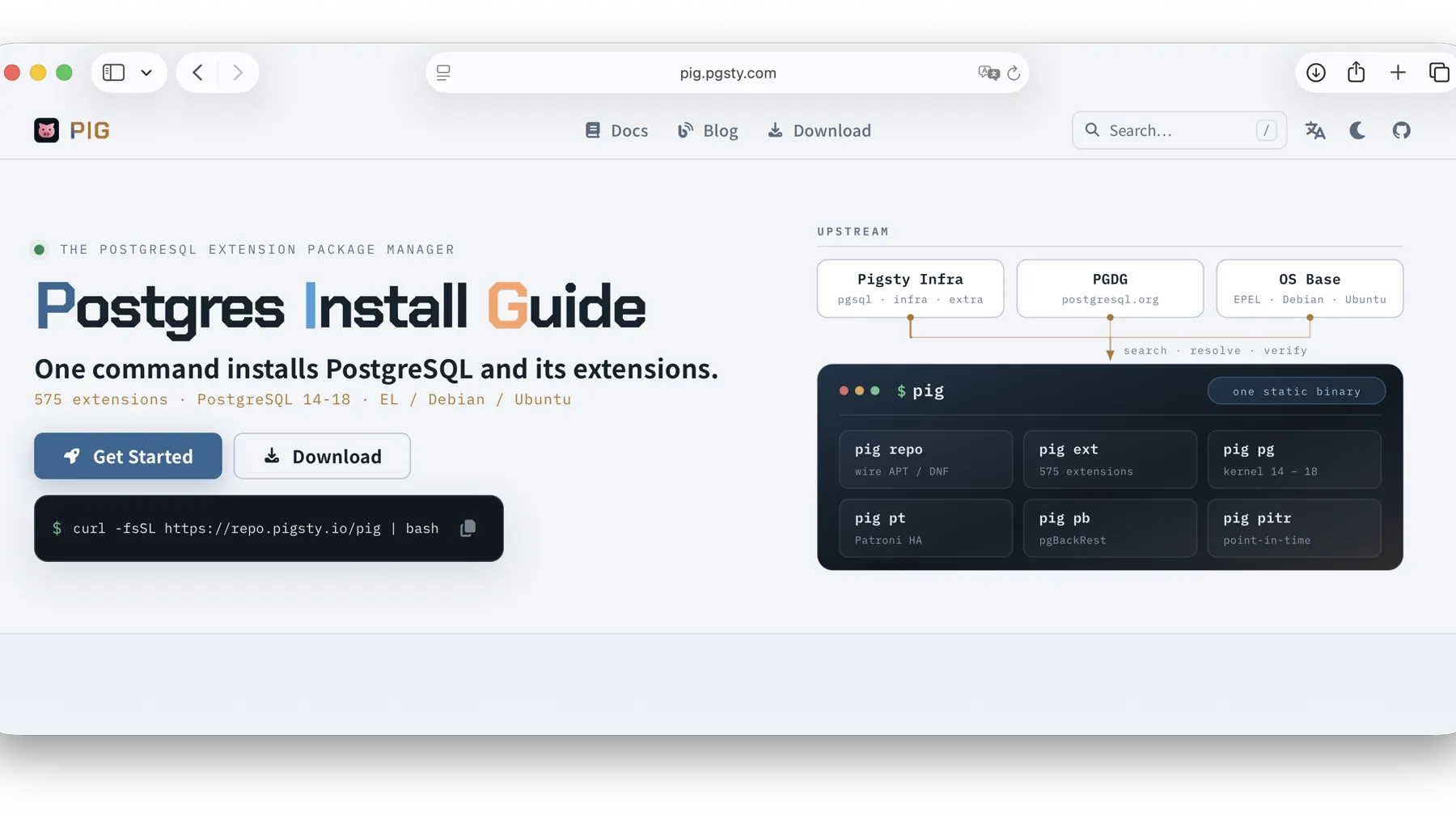
{avatar="images/ron-vonng.webp" date="2024-12-23" url="https://x.com/RonVonng/status/1871040275575124082" platform="x"}
Ron @RonVonng · X
Released pig, the PostgreSQL extension package manager and Pigsty CLI. One command configures PG repositories on mainstream Linux distros and installs hundreds of PostgreSQL extensions through the native package manager.
avatar resolves like any image. A value with a URL scheme is a remote
image that the reader’s browser loads directly. Any other value is looked up
as a page resource (or a resource of the section’s branch bundle), then a
global resource in assets/, and otherwise used as a path to the site’s
static files. Prefer page or assets/ resources, which the build always
finds. The name sits beside the avatar, so it is decorative (alt=""). The
card shows it small and crops it to fill its frame, so use a square image.
date is plain text, shown as written. A year-month (2026-11), a date
(2026-11-23), or a date and time with hours and minutes, optional seconds,
and an optional Z or ±HH:MM offset (2026-11-23 08:30,
2026-11-23T08:30:00+08:00) on a real calendar day becomes a
machine-readable <time datetime>; a space before the time is written as
T in the attribute. Anything else, including fractional seconds or a
+0800 offset, renders as plain text without <time>.
url turns the date line into a “View original” link. Give the post’s
HTTP(S) address (which receives rel="external") or a site-internal path;
an invalid URL warns and is dropped. It is optional, so you can still quote
a post that no longer exists.
The attached image is an ordinary Markdown image. This page turns on
image zoom, so it opens at full size.
Block attributes need markup.goldmark.parser.attribute.block: true, the
setting OINK already requires for callout icons and native Book figures.
Platforms
platform selects the brand icon and the platform name that screen readers and
RSS carry, and nothing else: every platform shares one layout, the preset owns
the colors, and the card never imitates a platform’s own interface. Without
platform the card shows no icon, so name the platform the post came from.
platform
Icon
x
fa-brands fa-x-twitter
bluesky
fa-brands fa-bluesky
mastodon
fa-brands fa-mastodon
threads
fa-brands fa-threads
weibo
fa-brands fa-weibo
zhihu
fa-brands fa-zhihu
telegram
fa-brands fa-telegram
linkedin
fa-brands fa-linkedin
none (default)
None (omits icon and platform name)
Source
> [!SOCIAL] Ron `@ron@fosstodon.example`
>
> OpenAI runs a single unsharded PostgreSQL cluster (one primary with 40+ read replicas) for its core workload. Vertical scale plus disciplined indexing still goes a very long way.
{platform="mastodon" date="2025-05-19 11:27" url="https://fosstodon.example/@ron/1002"}

> [!SOCIAL] `@pigsty.io`
>
> PostgreSQL is the Linux of databases: one kernel, hundreds of extensions, zero vendor lock-in.
{platform="bluesky"}
RRon @ron@fosstodon.example · Mastodon
OpenAI runs a single unsharded PostgreSQL cluster (one primary with 40+ read replicas) for its core workload. Vertical scale plus disciplined indexing still goes a very long way.
PostgreSQL is the Linux of databases: one kernel, hundreds of extensions, zero vendor lock-in.
The second card is quoted by handle alone, so it has no name, date or link.
Screen readers hear the platform name, which the card carries as visually
hidden text beside the decorative icon. An unknown or empty platform warns
and shows no icon. The handle appears exactly as written, because the theme
adds no @ and knows no per-platform rules: write @name for X and
@user@instance for Mastodon.
The body
The body is the callout’s own Markdown, rendered with the page, so
paragraphs, links, inline code, lists and footnotes work as usual. Everything
else a post can contain is written with syntax OINK already has, which is why
the card has no attributes for it.
Post content
Write it as
Text, links, code
Ordinary Markdown
One attached image
A Markdown image; image zoom applies when it is eligible
> [!SOCIAL] Ron `@RonVonng`
>
> One PostgreSQL documentation theme, two color schemes:
>
> ```gallery
> 
> 
> ```
{avatar="images/ron-vonng.webp" date="2026-11-24" platform="x"}
Ron @RonVonng · X
One PostgreSQL documentation theme, two color schemes:
Quoted posts
When the post quotes another, write the quoted post as a nested callout in
the body. Its attribute line carries one >, so it belongs to the inner
callout; the outer line follows without one. The inner card is compact (a
smaller avatar, name and handle on one line) and keeps its own date and link.
Leave platform off the inner card to keep the icon from repeating, or give
it for a cross-platform quote.
Source
> [!SOCIAL] Ron `@RonVonng`
>
> PostgreSQL 17 is out — billed as the world's most advanced open-source database. Before long, "open-source" may be the redundant part.
>
> > [!SOCIAL] PostgreSQL `@PostgreSQL`
> >
> > News: PostgreSQL 17 Released!
> {date="2024-09-26" url="https://x.com/PostgreSQL/status/1839292604854223176"}
{avatar="images/ron-vonng.webp" date="2024-09-27" url="https://x.com/RonVonng/status/1839521052843442618" platform="x"}
Ron @RonVonng · X
PostgreSQL 17 is out — billed as the world’s most advanced open-source database. Before long, “open-source” may be the redundant part.
Invalid input warns, and as long as there is a body, the quoted words are
kept.
Input
Result
No title, with body
Warns; the body renders as a plain blockquote, without the card. url survives only as the quote’s cite attribute; date, platform and avatar are ignored
No title, empty body, with url
Warns; renders a plain blockquote linking to url
Empty body, with url
Warns; a link-only card with the author line and “View original”
Empty body, no url
Warns; nothing renders
Unknown or empty platform
Warns; no icon
[!SOCIAL]- or [!SOCIAL]+
Warns; the fold marker is ignored
Invalid url or avatar
Warns; the attribute is dropped
Static avatar not under the project’s static/
Warns when static/ exists (ID social:avatar-static); keeps the path
Static avatar that climbs above the site root with ..
Warns (ID social:avatar-static); the avatar is dropped and the card draws the initial instead
Unknown attributes
Warn; ignored. class, data-* and aria-* pass to the card
Hugo’s x shortcode
Hugo ships its own x shortcode, {{< x user="…" id="…" >}}, and OINK
leaves it alone. It asks X’s oEmbed service for the post at build time, so a
clean build needs network access and the quote disappears when the post does.
Use a [!SOCIAL] callout for quotes that must build offline and stay
readable.
Output
The card loads no JavaScript. Print switches the card to the paper palette
regardless of screen color mode and prints the original URL after “View
original”. The Markdown and LLMS output keep the callout as written, with its
attribute line, so an agent reads the same blockquote the author wrote. RSS
carries the body (omitting <blockquote> on link-only cards) and an
attribution line with absolute URLs, without the avatar.
Reference
Title, inline Markdown, default—
The identity line, required. A code span in it is the handle
avatar, image source, default—
Remote URL / page or branch-bundle resource / global resource / static path; decorative. Without it, the card draws the first character (or a user icon)
date, plain text, default—
Shown as written; a year-month, date, or date-time (HH:MM, optional seconds, optional Z or ±HH:MM) on a real day renders as <time datetime>
url, URL, default—
Original post (HTTP(S) or site-internal path); links the date line
platform, enum, defaultnone
xblueskymastodonthreadsweibozhihutelegramlinkedinnone; selects the icon and the announced platform name
Body, Markdown, default—
The post; may contain images, a gallery fence, a video, footnotes, or a nested [!SOCIAL]
There are no attributes for engagement counts, verification badges, image
lists or quoted posts; images and quoted posts go in the body.
Limits
What you may quote, and which avatars and media you keep in the repository,
is your decision. When the original no longer resolves, remove url; the
quote itself stays.
There are no likes, reposts, view counts or verification badges, because
such numbers are snapshots that go stale.
Platforms differ only by their icon; there are no platform skins or brand
colors.
Threads, replies and polls are not modeled. Quote several posts as several
cards, separated by a blank line.
A plain Markdown viewer shows the [!SOCIAL] marker and the attribute line
as text, and no avatar, because the avatar is an attribute.
The static avatar check reads only the project’s own static/ directory,
and only when it exists. A file that a module mount or a custom staticDir
publishes also warns; list social:avatar-static under the site’s
ignoreLogs to silence that warning. The build skips remote avatar checks.
Prefer page-bundle or assets/ images and inspect the rendered card before
publishing.
 · X


