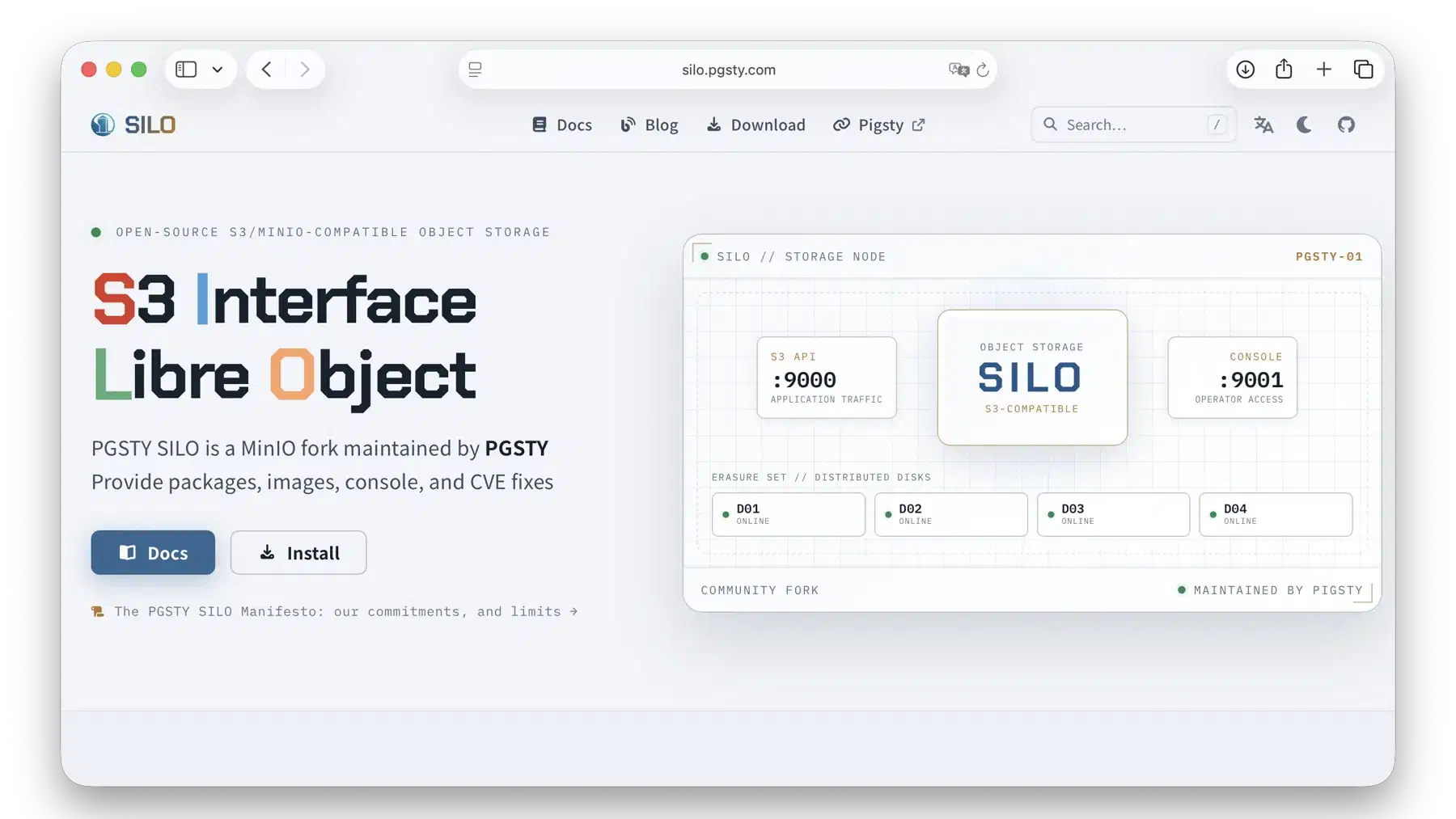
silo.pgsty.com
silo.pgsty.com documents SILO, an S3-compatible
object store. The case snapshot counted 411 pages per language. A migration
manifest covering 387 upstream pages generates data/docs_nav.json, which then
drives the documentation sidebar. The site also has module taxonomy and a
download page.
What it demonstrates
- Migrating a large upstream manual without flattening its information design.
- Generating navigation from a checked manifest instead of hand-maintaining it.
- Layering local bilingual content, taxonomy, and downloads around imported docs.
Use this pattern when the upstream corpus remains authoritative but the local site needs its own navigation, language peers, and product surfaces.
Follow the navigation data boundary
The committed data/docs_nav.json
records its inputs in meta.generated_from (migration/reports/navigation.csv)
and meta.manifest (migration/minio-docs-manifest.csv). The migration process
owns those inputs and the generated navigation; OINK consumes the resulting
tree. Those input paths describe provenance, not a generator bundled with OINK.
This trades a second, site-maintained navigation artifact for control over an imported manual’s order. Use the ordinary content tree for a small original manual; adopt generated navigation only when you also maintain its source and regeneration procedure.